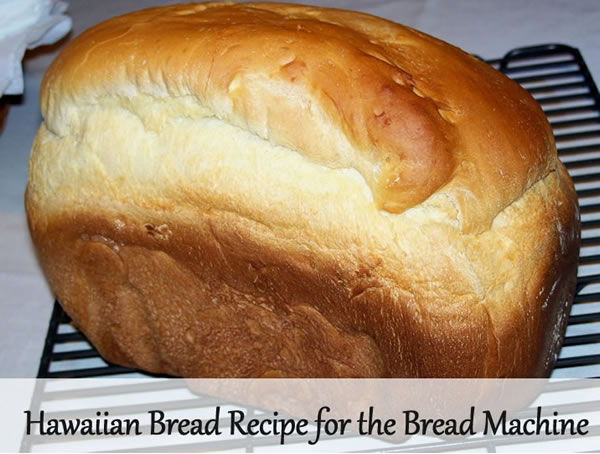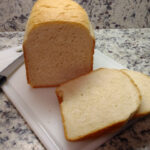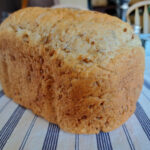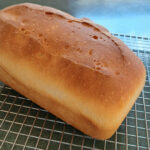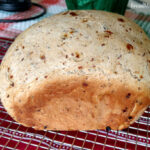

My experiment with Hawaiian bread mix made me curious about Hawaiian bread. What would it taste like if I made it from scratch? As it turns out, it tasted even better than the mix.
Hawaiian Bread
¾ cup pineapple juice
1 egg
2 Tablespoons olive oil
2 ½ Tablespoons sugar
¾ teaspoon salt
3 cups bread flour
2 tablespoons milk
1 ½ teaspoons yeast
This makes a two pound loaf. Follow the instructions that came with your bread machine in terms of which ingredients to put in the bread machine first. Make sure you check on the dough after five or ten minutes of kneading. Just pop the top of the bread machine and see how the dough is doing. It should be a smooth, round ball. If it’s too dry add liquid a tablespoon at a time until it looks OK. If it looks too wet, add flour a tablespoon at a time until it looks OK. Most of the time though, the above amounts should be just right.
I made mine with the bread machine set at medium crust. It came out a little darker than I’d like. The next time I’m going to use the light crust setting.
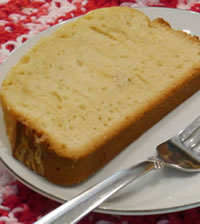
We found the crust to be extra flaky and the bread had a cake-like texture. It was great!

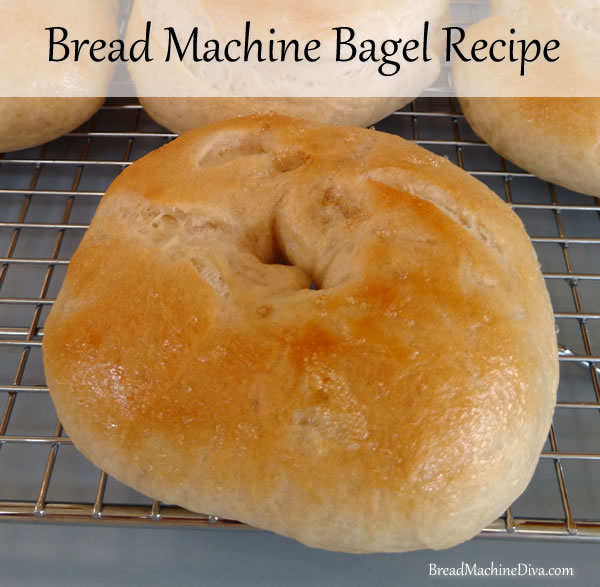
All the bagel recipes I’ve ever read call for putting the bagels in boiling water before they go into the oven. This recipe doesn’t. How do the bagels taste? They may have been a little heavier than other bagels I’ve tried, but they tasted fine. We split them, added cream cheese and had a lovely breakfast.
Cinnamon Raisin Bagels
1 1/2 Cups water
1 teaspoon salt
1 Tablespoon dark brown sugar, packed
4 Cups bread flour
1 teaspoon cinnamon
1/2 Cup raisins
2 1/4 teaspoons yeast
Follow the instructions that came with your bread machine in terms of which ingredients to put in the machine first. Set the machine on the dough setting.
When the dough is done put it on a lightly floured surface. Divide the dough in half. Then divide those pieces in half. Keep going until you’ve got 12 equal pieces of dough. Then roll each piece until it’s a 10 inch long rope.
Form each rope into a circle and place on two greased cookie sheets. It’s OK to give the ends a little pinch to make sure things stay together. Cover them with towels and let rise for 30 minutes.

(Please excuse the state of my pans. One of goals for 2010 is to get new ones.)
Bake in a 375 degree oven for 15 mintues. Then turn the bagels over and bake for another 10 minutes.

The bagels were a little more brown than I’d like. The next time I make this recipe I’ll decrease the cooking time by a few minutes. It was a winner though, so I will be making this one again.
We started out the new year with a treat from the mother of the Man of the House. She’s Dutch and sent us a box of hagelslag (dark chocolate sprinkles). In Holland people put these on buttered toast. We used them on sandwich bread. Delicious! It was a fun way to start out 2010.

For Thanksgiving dinner I served apricot dinner rolls based on my apricot bread recipe. The rolls ended up fine, but were a little too brown on the bottom. I’m going to play around with the recipe a little bit and then I’ll pass it on to you.
In the meantime I’ve been enjoying the free eBook, How to Bake, from The Prepared Pantry. I really enjoyed the section in chapter three about baking bread on the grill. Have I tried it? Nope, but if I do you know that you’ll hear about it.
I hope you all have a wonderful Thanksgiving!
We’re going to have family over for dinner. We’re going to have ham with an apricot glaze. I’ll use the apricot bread recipe to make dinner rolls. I’ll let you know how it turns out.

As I gazed at this box of bread mix in Walmart, I realized that I’d never purchased bread mixes for my machine. Once we were given a few by a friend, but that had been years ago. I couldn’t even remember how the bread turned out.
Were mixes any good? Would I like them? Would I be able to taste the difference?
I decided to try it out.
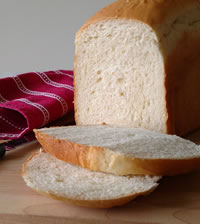
The bread looked and tasted fine. I thought it was fantastic toasted with peanut butter on it. The Man of the House like it but said it had a “funny texture.”

Making bread with a bread machine isn’t hard. I make sandwich bread about once a week. It takes about 15 minutes including cleanup. However using a mix was much easier and faster.
The Man of the House and I haven’t done a firm workup on how much it costs to make a loaf of bread. We buy our flour, yeast, salt and sugar at Costco. Our rough estimate is that it costs us about fifty cents to make a loaf of bread. Even if it’s double that, a mix is much more expensive than making a loaf from scratch.
So this mix gets points for ease of use and bread quality. The cost is reasonable for a mix, but more expensive than making bread from scratch.
Have you ever made a loaf of bread that has a valley in the middle? That’s the sign of a loaf of bread that rose and then fell. I had a loaf like this back in July.

While I can’t find any scientific research to back me up, I think this was a problem caused by the record-setting heatwave our area was experiencing.
Other, more common, causes of The Big Valley are:
- Too much liquid
- Too little salt
- Too little flour
- Too much yeast
The good news is that this problem doesn’t usually affect the flavor of the bread. So if I like the way the bread tastes, I’ll try making it again. This tests to see if I measured correctly. If that was the problem then the second loaf will turn out fine.
If the second loaf comes out with a dip in the middle, I adjust the above ingredients or find a slightly different recipe. How long will I keep it up? I think the final version of this potato bread recipe was my sixth try.
We really like our new location and the rental house. One of the few problems is the stove. It’s about 25 years old. The burners have a mystery substance melted on them. The timer knob is missing. The clock no longer works. Most annoying of all, the oven seems to run hot.
It was time for the oven thermometer! These little gadgets are handy and inexpensive. If your oven doesn’t heat properly I suggest you get one. It’s well worth the six dollar price.
I put the oven thermometer inside the oven and then turned it to 350 degrees. The first thing I noticed was that the oven light went out at about 200 degrees. Was the oven resting? Did the heat need to equalize? I’m not sure. After half an hour, the oven stabilized. It stabilized at 400 degrees! No wonder our food had been burnt.
I played around with the oven for an hour or so. I changed the temperature and noted how long it took the oven to make the switch. I also observed how much the temperate inside the oven varried from what I’d set.
In the end I discovered that our “new” oven takes about half an hour to warm up. It also heats to about 50 degrees higher than the temperature I set. Knowing this gave me two benefits.
Benefit Number One – Armed with this knowledge, Mr. Diva and I went to our landlords and asked for a new stove. They agreed!
Benefit Number Two – Now that I understand the oven’s quirks, I can work with it. I warm up the oven well in advance of baking. I also set the temperature fifty degrees cooler than what I really need. Last weekend I baked two batches of hamburger buns and not one of them was burned.
While I’m very excited about getting the new stove, I’ll be able to deal with this one for now.
Sorry that posting has been so spotty the last few months. We’ve been in the middle of a move. It’s not a typical move either. We moved from our house located in a city of 120,000 people. Now we live outside a town of 9,000. It used to be that a grocery store was in walking distance. Now the grocery store is a 15 minute car drive away. Here there’s no traffic noise, just the sound of birds and wind moving through the pine trees.
We’re unpacking, figuring out where everything is and where to put things in the new house. It seems never ending. But yesterday we passed a milestone. Yesterday, for the first tine, I made bread in the new house. As the scent of baking bread filled the air, the new house felt like home.
Recent Comments