

High Altitudes and Your Bread Machine
Wondering about high altitudes and your bread machine? I get it! Over the last few years I’ve lived at sea level, 4,800 feet and at 3,700 feet. Here are some hints for adjusting bread machine recipes so that they work, no matter the altitude.
Last Updated January 19, 2026 – Originally Published July 17, 2017
The recipes on this site were developed when I lived along the Pacific coast. In other words, the recipes were developed at sea level.
However, in 2022 I moved back to the mountains where I grew up. For a time, I rented a place that was at 4,800 feet. Then I bought a home at 3,700 feet. Let me tell you, the altitude makes a difference in using the bread machine!
What Altitude Affects Yeast Bread?
In my experience, bread recipes will work without adjustments until at least 3,700 feet. At 4,800 feet I needed to make changes.
This differs from what the experts say. They recommend that at elevations of 3,000 feet or more you’ll need to adjust your bread recipes for higher altitudes.
My advice is that if you live at 4,000 feet or below, at least consider trying a yeast bread recipe as written.
Why Higher Altitudes Affect Baking
At higher altitudes the air pressure is lower. That makes the dough rise faster. It also means that moisture evaporates more quickly. That can translate into dry or misshapen loaves of bread.
The Colorado State University Extension website points out that this shortened rise time can even affect the flavor of your bread.
Hints for High Altitudes and Your Bread Machine
As with any adjustments to a recipe, make small changes and document it. View the results and make more adjustments as needed.
Here are the adjustments I made for two-pound loaves of bread. If your bread machine makes one-pound loaves, then cut these adjustments in half.
- Decrease yeast – at 4,800 feet I used about 25% less yeast that I did at sea level
- Increase liquid by 1 to 2 Tablespoons
- Decrease sweetener by 1/2 teaspoon
- Increase the salt slightly
- If the recipe calls for the medium crust setting, try the light crust setting
- Try using flour that has a higher protein count. Another way to tackle this issue is to use vital wheat gluten.
- ALWAYS check the dough after five or ten minutes of kneading. It should be a smooth, round, ball of dough. Make corrections as needed.
Be Aware of the Humidity
When I moved to the mountains the altitude wasn’t the only thing that changed. I’m now in an environment with much lower humidity.
Humidity affects baking because flour can absorb humidity from the air. If you’re using the dough cycle of the machine, this can lead to soft, sticky dough. If you’re making a loaf of bread in your bread machine this can lead to a loaf with a sunken top.
The fix for high humidity is to lower the liquid in the recipe. The fix for low humidity is to Increase the liquid in the recipe.
What About at Quick Bread at High Altitudes?
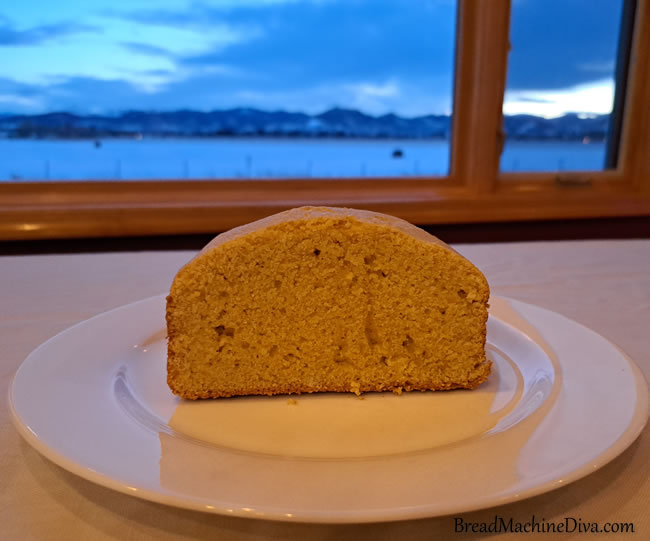
Cornbread at 3,700 Feet
Yeast bread recipes need to be adjusted for altitude starting at 3,000 feet. But what about quick breads that use baking powder as a leavening agent?
I researched the matter and didn’t get any clear answers. So I tried my bread machine cornbread recipe to see what would happen.
The recipe works fine at 3,700 feet with no adjustments.
However, if you’re baking at high altitude and the center collapses, try slightly reducing the baking powder. For elevations above about 6,500–7,000 feet, start by reducing it by 25% to 30%.
No Universal Adjustment
One thing that makes this whole situation challenging is that there’s not a one-size-fits-all adjustment for high altitudes.
Is your humidity high or low? Are you at 4,000 feet or 6,000 feet? The adjustment for each situation can be a little different.
Success Story – High Altitude Sour Milk Bread Recipe
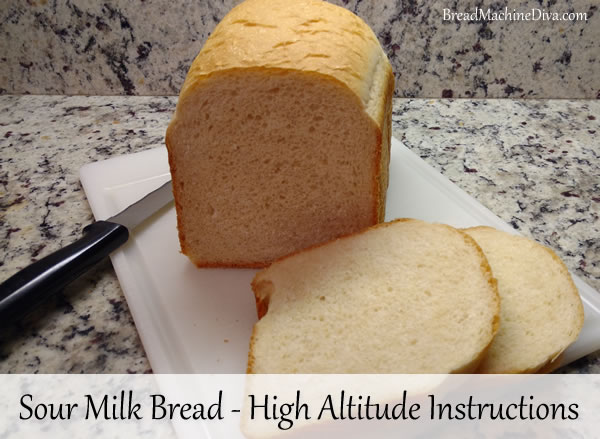
I made this lovely loaf of sour milk bread at about 4,800 feet. I’ve added the high altitude instructions to the recipe.

Hi, I moved from NC to CO, a VERY different altitude. I am near Denver, CO, and at an altitude of about 8,481. I made bread in my bread machine from a mix called Ketonia. The ingredients are: Vital Wheat Gluten, Flaxmeal, Oat Fiber, Almond Flour, Salt, Citric Acid, and Xanthan Gum. The bread crust was ugly and a little hard, but the bread itself was “OK” but a little chewy; soft and similar to white bread consistency. However, it did not rise as much as I would have liked. I cut it on the side so it looked like Artisan slices; edible but not very appetizing. With this type of flour, should I still add a few tablespoons of water and decrease the yeast? Are there any other tips for this high altitude with the same type of flours? I have a hard time digesting whole wheat.
I want to start with a little disclaimer: My recipes and expertise are focused on traditional bread machine baking. I don’t really work with Keto mixes, as they behave very differently than standard wheat flour.
However, looking at your results, here are two ‘high-altitude’ hints that apply to almost any bread machine loaf:
The ‘Thirsty’ Ingredient Rule: At your altitude, the air is incredibly dry. Additionally, ingredients like flax and almond flour soak up much more liquid than regular flour. Since your bread didn’t rise and the crust was hard, your dough was likely too dry. I would suggest increasing your water by 2–3 tablespoons next time.
Don’t touch the yeast yet: Normally, we decrease yeast at high altitudes to prevent a collapse. But since your bread was short and dense, it likely didn’t have enough moisture to move. Keep the yeast amount the same for now and see if the extra water helps it ‘stretch’ more easily.
Try the ‘Light’ Setting: To help with that ‘ugly/hard’ crust, try using the Light Crust setting on your machine. In the thin mountain air, crusts tend to set and toughen much faster.
Since I don’t specialize in those specific flours, you might also want to check the Ketonia website or community groups, as they might have specific ‘high altitude’ tweaks for their proprietary blend!
Just made the Sour Milk bread at 7,000feet here in Colorado. Followed the instructions exactly. Turned out perfectly!!! Thank you! Any other recipes you have for high altitude I would love to see!
Thanks so much for the kind words and the inspiration! I need to test/develop more recipes for high altitude.
New to bread machine and living at 7300. First attempt was a chocolate pound cake. It tastes good but looked terrible, the center was about 3 inches below the sides and was not cooked. Will try bread this weekend and start to adjust the recipe for high altitude.
Let me know how it goes!
I am looking forward to using my new breadmaker. I live at 3,200
I live at 4300 feet and we call my beginning bread loafs “doorstops”! I have adjusted and learned and –after many goofs have got it.
My home is located at just under 6,000 feet. The first loaf I made in my new machine looks like a truck ran over it, then backed up. And it weighs a TON! I read, above, where you can decrease the yeast by 1/4 t, and liquid by 1 to 2 T. I only use one T sweetener for wheat bread. I have no way to adjust the temperature on my machine. Do those small adjustments make that much of a difference?
Are there any other suggestions?
Yes, the suggestions should help. However, it sounds as though this was a new recipe in a new machine. So maybe there’s a problem with the recipe. You might want to start weighing your flour. A cup of bread flour should weigh 4.25 ounces.
Have almost gone crazy trying to get a really good loaf out of my $300 bread machine at 4,900 ft. By far the most important changes I’ve made are reducing the yeast and lowering the proving temperature. You can also reduce the proving time, but lowering the temp allows for a slower proving over the normal period of time, which for me has produced a better texture.
I’d love to be able to change the temperature. There isn’t a way to do that on my machine. What sort of bread machine do you have?