

Bread Flour Versus All-Purpose Flour
What is bread flour? How does it differ from all purpose flour? I investigated and it turns out that the difference is gluten.
Updated December 21, 2025 – Originally posted on September 21, 2009
When I started making bread, I read the instruction manual of the machine. It advised using bread flour. But what is bread flour? How does it differ from all purpose flour? I investigated and it turns out that the difference is gluten.
Gluten is a type of protein found in flour.
More gluten in the flour makes the bread slightly heavier, but more importantly, it makes it stronger. That means that as the yeast ferments, the bread will hold the carbon dioxide and rise.
If the dough isn’t strong, then the carbon dioxide will escape and the bread won’t rise as high.
Bread flour has more gluten than all-purpose flour. However, the amount of gluten in particular brands of flour varies.
In general, all-purpose flour has a gluten content of 9% to 12%. Bread flour typically has a gluten range of 10% to 13%. Note the overlapping areas.
If you’re using all-purpose flour in your bread machine and it works for you, that’s great. Your brand of flour must be in the upper range of the gluten levels.
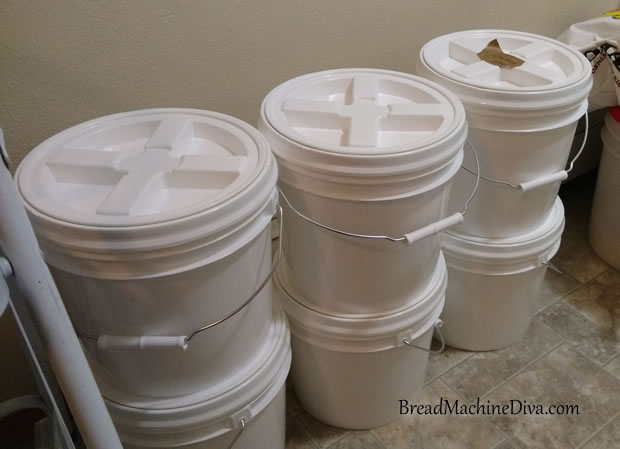
Storing a lot of flour is SO much easier with Gamma Lids!
I make ALL the bread for our household with my bread machine. (Really!!) As you might guess, we go through a lot of bread flour. Learn where we buy flour in bulk and how we store it.
What if You Only Have All-Purpose Flour?
Look at the packaging to see if the gluten content is high enough for use in the bread machine.
Check out the website of the manufacturer of the all-purpose flour. It may have the gluten percentage of the flour there.
If the gluten percentage isn’t listed or it gives a range, then make an experimental loaf of bread. The worst that will happen is that the bread won’t rise as high as normal.
Even if your all-purpose flour doesn’t have enough gluten, it’s okay to use it in the bread machine. Again, the worst that will happen is that your bread won’t rise as much as it would have with bread flour.
Vital Wheat Gluten to the Rescue!
If your all-purpose flour doesn’t have enough gluten, don’t worry. You can fix that by using vital wheat gluten.
At my grocery store vital wheat gluten is in the Bob’s Red Mill area. If you order it online, check out King Arthur Flour’s vital wheat gluten. (You can never go wrong with their products!)
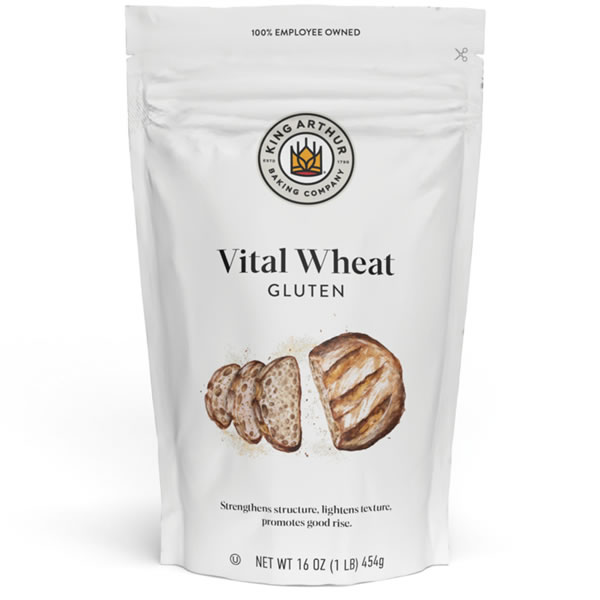
While vital wheat gluten looks like flour, it’s not. It’s basically powdered gluten.
Add one teaspoon of vital wheat gluten per cup of flour. For example, if the recipe calls for 4 cups of bread flour, then add 4 teaspoons of vital wheat gluten.
Note that you may need to experiment with the amount of vital wheat gluten needed.
If you add vital wheat gluten, be sure to take a look at your dough a few minutes after it starts kneading. You may need to add a little liquid. Also, if the bread doesn’t rise enough, you may need to add a little more vital wheat gluten on your next loaf of bread.
Wondering about other types of flour?
Cake Flour has the lowest gluten content of all. Its gluten content is in the 5% to 8% range. Cake flour is generally bleached. The bleaching slightly damages the flour’s starches as well as weakening the gluten. This enables the flour to absorb more liquid and rise higher.
Cake flour is used for cakes and other baked goods that are soft and tender. Cake flour is not recommended for making bread.
Pastry Flour is sometimes called cookie flour. It has a gluten content of 8% to 9%. It’s frequently used for pies, tarts and many cookies.
Like cake flour, pastry flour is not recommended for making bread.
You can make your own pastry flour by mixing together 1 1/3 cups all-purpose flour with 2/3 cup cake flour.
Self-Rising Flour contains baking powder and salt. This staple of Southern cooking is used for biscuits, muffins, and pancakes.
You can make your own self-rising flour by combining 1 cup all-purpose flour with 1 1/2 teaspoons baking powder and 1/4 teaspoon salt.
Whole-Wheat Flour is called wholemeal flour in the UK. It’s made from the whole kernel of wheat.
Whole-wheat flours are high in protein but have problems forming gluten. That’s why many recipes for whole-wheat bread call for the addition of vital wheat gluten.
Gluten-Free Flour isn’t made from wheat. There are many types of gluten-free flour. Some of the most popular types are almond flour, buckwheat flour, and sorghum flour.
Since bread depends on gluten, making bread with gluten-free flours is a challenge. It’s a whole different type of baked good.

Interesting. I have food allergies to Gluten. I was wondering why I could handle making bread with All Purpose Unbleached Flour, lower amount… I will stick with it, now I am intrigued with Almond Flour.
Here in the UK, we have “Plain” flour, is this the same stuff as you call “All Purpose” flour ?
Many thanks for all the hints and tips
Great question! I did a little investigation. In most instances, plain flour and all-purpose flour are the same thing. I say “in most instances” because all-purpose flour has a higher gluten/protein content than plain flour. That means that if you’re making something like a cake or pastry, you’ll want to use cake flour as a substitute for plain flour.
While you are correct about the differences in types of flour, I used Kroger All Purpose White Flour and compared this to their Bread Flour. Rise times and heights were identical. Baking time, and non enzymatic browning (Maillard reactions), were also identical. Apparently there regular flour is just as good as their bread flour, but substantially less expensive (22¢ per pound vs. 88¢ per pound!). Good crumb, nice crust, with soft and chewy (in a good way) mouthfeel.
Great information!
That’s interesting! I always use Kroger All Purpose flour in my bread machine, but I always add gluten. I don’t think I’ve ever tried to make bread without the extra gluten, but maybe I should try!
Can I use a sourdough starter in my bread machine with regular flour mixed with bread flour to make a loaf of french sourdough bread?
I adore sourdough, but it’s hard to use sourdough starter in bread machines. So this may work, however I have no idea what the recipe would be like.
I purchased hard white wheat flour, I have never used this brand before. I have made two loafs in my bread maker and both did not rise as high as my bread normally rises. Do you have any answers for me as to why?? Please HELP
It might need some vital wheat gluten.
Here is my question regular bread flour is scarce however I have no trouble finding bread machine flour. Can I interchange bread machine flour for bread flour. I’m making sour dough bread from a starter.
Great question! Bread flour and bread machine flour are the same thing. So interchange away! 🙂
I have found a big difference in wheat also. Soft white wheat flour is better for bisquits but hard to find 100% soft wheat. Most flour is made from hard wheat berries.
Palouse, in Washington State sells Soft White Wheat Flour. At least this is what I have read on their site. Check it out. And good luck.
Can I use bread flour without using a bread Machine?
Sure. That should work out fine.
I have struck gold! I found this site out of sheer desperation. Thank you so much for this website full of tips and advice. I live in South Africa and you guys just don’t realise how lucky you are to have such a big variety of flours to choose from.
I have been baking bread in the same bread machine for 15 years (nothing like I see on your site) and since moving to another province (higher altitude and drier climate) my bread has this big valley with a top that crumbles and a heavy bottom. I have tried using warm or cold tap water, room temperature or cold butter, white or brown sugar, honey or molasses, different oils and yeasts but still the valley prevails. Fortunately I live alone (no critique) and eat the bread anyway but would like to solve the problem.
Thank you for this most interesting site.
Thanks so much for writing! Hopefully you’ll be able to find something on the site that will help. Here’s an article on bread that rises and then falls. You might also try making sour milk bread. At times I’ve had problems with different chemicals in the water. Sour milk bread is a good way to test for that issue.
Just got a used bread machine. I appreciate your web site and also your users questions. Your answers are helpful and it is very nice that if you don’t know the answer, you tell us. I have yet to use the machine but when I do I will return to this website for sure!
Thanks so much! I hope you enjoy your bread machine.
Would mixing bread flour with APF make less dense bread? Has anyone done this? I love the taste of the bread ( I have the Zoj Pac,,,just got it and have made 3 loaves of the quick bake regular bread)…but it is heavy. Would like to know about less dense bread…thanks!
Want to know a recipe for whole wheat sprouted flour for bread maker machine bbpac20. Thank you
I’m sorry, but I haven’t worked with whole heat sprouted flour. 🙁
I’ve used WWSF and compared it to stone ground whole wheat flour, and found no difference in blind tastings between the two among three different people. Spring and crumb were so close that I’d need some kind of mensuration device (I know they make them, but I imagine that they’re also quite expensive!) to determine any measurable difference there. Flavor, aroma, and texture were identical (at least we couldn’t tell the difference in a blind tatsting) with the only difference being that the WWSF cost $15 for a 5 lb. bag, while the stone ground whole wheat flour was $5 for a 5 lb. bag. Was it 3 X better? I doubt it from what I’ve seen so far, but as with all things, YMMV! Great web site Marsha, and thanks again for being such a great contributor to the bake at home community!
I’m so sorry, but what does WWSF stand for?
I am also very curious as to what WWSF stands for in that suggestion Michel wrote. Would love to know what the answer is myself. Thanks Dorinda
WWSF is whole wheat sprouted flour, for the questions that follow this entry.
Thanks for clearing up that mystery!
Can I use ground Himalayan sea salt in the whole wheat recipe?
I haven’t worked with that sort of salt before, but I imagine it would be fine.
Hi Wyona, Yes but you will not get any taste difference over table salt this time. I’ve done that as well as kosher flaked when out of regular table salt.
I have used all purpose flour instead of bread flour. I found I had to use about 15% more ingrediants and about 25% more yeast to get a full size loaf. The bread was denser, but very good.
Absolutely love your site, and so glad I found it. I too love my Zo… i’ve had others over the years (my first was a Hitachi that made really good vertical loaves, but when it died I went through a real ordeal to find something decent… and then I found my Zo).
Nice to see a site that’s both dedicated to bread machine usage and in many cases the Zo line of breadmakers themselves. I like mine so much I purchased a second pan and set of blades so I can batch loads one behind the other. You need to give it a little time to cool down between loaves (so you don’t overhead during the mix and rise, or potentially kill off the yeast), but it gives me more flexibility. The added bonus is that you can be mixing one batch of dough for manual loaf forming, and while working that loaf into shape, you can have a second batch of dough being prepared.
Cal, What a great idea bout having a second pan and blades! There have been times when I sure could have used that.
I made yeast rolls with bread flour but they turned out heavy like buiscits
What did I do wrong
I’ve made them in bread machine with all purpose and they were lighter but I still would like a soft outer crust
Why don’t you give this butter bun recipe a try and see how it goes. I’ve had great results with it.
Fasting and not supposed to eat bread with levening agents in it. Does anyone know what types of bread that would be?
Any bread that uses yeast is considered leveaned bread. Flat breads are unleavened. Google unleavened bread recipes there are plenty these days.
I have an older Zojirushi bread machine and want to make corn bread, mine only has basic, mixed, wheat, but no cake. what can i do for the proper setting?
Mark, Thanks so much for writing. Do you have the model number of your Zo? I did a quick search on the Internet and couldn’t find anything that matches its description.
Can I make bread without a bread machine with bread machine
flour?
I would think that would work. If you try it please let us know how it works out.
Yes, better for bread flour will work in any bread recipe and make it stellar!
At anytime after the initial dough is taken from the bread machine, do you let the dough rise again? Or just use it straight from the bread machine?
I have to make dough at home and bring it to a school to finish the pizza. Can I freeze it?
Hi Bonnie, You’ll need to look at the individual recipes to see about how to handle the dough after the it comes out of the machine. I know of people that have frozen dough, but I haven’t done it myself. It’s on my to-do list though. I’ll blog about it when I’ve done it.
what can you do if there is only all purpose flour available?
Hi Geri – I haven’t done it myself, but I’ve heard that adding vital wheat gluten to all purpose flour does the trick. Add one half to one teaspoon per cup of APF. If you do try this let me know how it goes.
I use strictly AP flour in my bread machine. I do not add gluten, instead I mix together the water (or milk), sugar and yeast and let it start to work before adding the flour salt and other ingredients. It usually takes about 10 minutes or so for the yeast mixture to start foaming. I know it is ready for the flour at that point. The bread is a little heavier…more like a french bread, but I prefer mine that way.
So Im confused….aren’t we striving for a lighter bread? If gluten in higher in bread flour and makes for a heavier bread, then why not use AP? I think I misunderstand here lol
I think I may go back and tweak the article because it does sound confusing. The gluten also helps to make the bread stronger, not just heavier. This allows the bread to rise higher and better.
I get the best results using multiple flours. I typically use half bread flour and 1/4 all purpose and 1/4 wheat. All my flours are organic and come from King Arthur.
But what makes the most difference is using duck eggs in my bread. I put 2 eggs in the regular recipes by adding them to the water (so you end up with the same volume of liquid).
They make the bread rise and so amazing that I started having to reduce the other ingredients so the bread doesn’t touch the top of the bread machine.
I have a Zojirushi BB-PAC20 and love it. Searching for a recipe to make hamburger buns using that bread machine is how I found this site.
would like a response as to when the bread is rising before the cook cycle (the last 60 minutes). The dough rises very nicely, and just after the cook cycle starts, the top of the bread slowly falls a little. What does this mean?
Neal – How did the bread look at the end? I sometimes get something I call “The Big Valley”. If that’s what happened these tips may help.
Newbie here, family baker. I feel bread flour is smoother texture. Wondering if corn starch or eggs might improve protein ratio or lift when I run out and use APF…
I haven’t done it myself, but I’ve heard that adding vital wheat gluten to all purpose flour does the trick. Add one half to one teaspoon per cup of APF. If you do try this let me know how it goes.
I actually prefer all purpose flour on some bread machine recipes if I want a lighter bread, and as someone already said, bread flour is more expensive. Still experimenting with either of the two and I have even tried making gluten free bread which uses a totally different kind of flour.
My regular Costco went for a period without having their normal bread flour, in its place was Chapati. The nutritional anaylsis (protein) was impressive; it is also high in gluten so it can be stretched til very thin. I have been experimenting with it in my bread machine. I mix it about 50/50 with bread flour. It imparts some bitterness so I have been changing the ratios of sugar and yeast . Has anyone used Chapati flour to make a loaf of bread instead of more traditional flat breads?
I read on another site that using 1 tsp of wheat gluten per cup of all purpose or wheat flour is okay. Bread flour is pretty expensive where I live and I don’t have a Costco conveniently located. Does this measurement sound right to you? Also, I wanted to tell you that I LOVE your website. I’ve copied down many of your recipes. I do have the new Zojiruishi and am thrilled with it. It really is the “cadillac” of bread machines and worth every penny!
Deborah, Thanks so much for the kind words about my site. And I’m so happy that you like your Zojirushi. I adore mine!!!
I’ve read that adding one tablespoon of of gluten to one cup of regular whole wheat flour will make it better for bread machines. I’ve never tried it myself though. If you try this please let us know how it works.
In our area (Nebraska), there is a noticeable difference in price between general purpose and bread flour. I have always used a tablespoon of vital wheat gluten per cup of gp flour for bread. Also, if the flour is a little older or otherwise less reactive, I add a teaspoon of baking soda to the batch. I also use nothing but Zojiruishi – just got the ‘mini’ version as we are moving into a 5th wheel camper for some full time adventures.
Wayne, Thanks for flour hints. And best wishes for life in the fifth wheel! What a great way to see the country!
I have the Zoejurusi too.. use it a lot.. I have a small Zoe in Florida & a big one in Ohio. I wore my 1st small, “original design” Zoe out. My son found a “little used” original Zoe at the local Habitat for Humanity. He knew how sad I was.. without my Zoe!
Can wheat free, gluten free flour with correct amount of guar gum and other essential ingridients be used in a bread machine?
Hi Alan ~ That should be fine. You’ll need different recipes to make sure that you get the proportions right, but other than that there should be no problem.